Posts

Showing posts with the label Reading

Week 14 Reading Notes: I lied, this is the real final post of the semester!

Image
And here I am going back in time to week 14 to finish the semester. I wanted to take this last post to go back over the Jataka Tales and why I think they are so important. Every culture has their own stories they tell children. Some more than others are more direct on the messages they're trying to send, but to me, it makes it better that these are so direct. When we want to be able to raise someone with the right values or ethics, it's important to start getting that across to them early. Compare the tales to that on the old lady who swallowed a fly that some of us grew up with. Where swallowing a fly, then other things to cover the last thing swallowed leads us to see that you cant just keep using something to take care of the next thing. At some point we need to stop and hit a stable point instead of digging a deeper hole for ourselves. It can be hard to understand that for someone younger reading. In these tales I read in class, it's very deliberate on how blunt...

Week 15 Reading Notes: THE LAST ONE!!!!!!!!!!!!!!!!!!!!!!!!!!!!!

Image
And here we end my journey through every tale we could read in class. I really enjoyed these, and I hope people liked the stories I made from them. In this story, a fox, a hare, and a wolf get involved in a bit of a game of cunning. A hungry wolf is about to eat a hare, when the hare offers a plump fox as dinner instead. Taking up the offer, the wolf follows the hare. Trying to deceive the fox, the hare tries to lure it into a false sense of security. Sensing something is at play, the fox outwits the hare with a secret trap. Upon entering with the wolf, both the hare and wolf become trapped together, in which the wolf devours the hare. The fox slips away in his secret exit. Games of with and cunning are always fun to read, especially when the loser deserved it all along. From: The Hare, the Fox, and the Wolf by Maude Barrows Dutton An adorable Alaskan Fox

Week 15 Reading Notes: The Last Week

Image
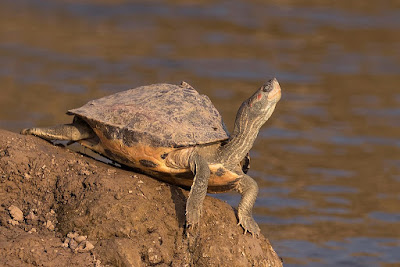
All semester long I've loved the Jataka Tales. Little did I know I was missing out on some other tales! In an odd friendship, a scorpion and a tortoise become inseparable. The two were so close that when forced to move, the tortoise offered to take the scorpion on his back across the stream. Well, curiosity kill the cat (the scorpion). The scorpion wanted to see if he could sting through the tortoises shell, and the tortoise promptly flipped over, making the scorpion fall into the river. This is almost akin to parent who just want the kids in the car to be quiet on a road trip, though this was written much before normal car rides! From: The Scorpion and the Tortoise by Maude Barrows Dutton This poor little guy didn't make it

Week 13 Reading Notes: Silence is Golden

Image
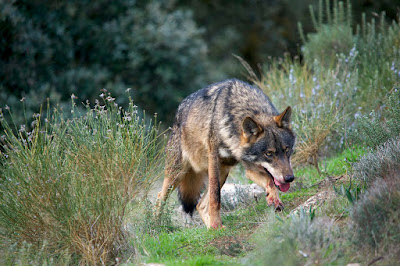
Out of all the Jataka tales, this one came across, to me, as the most sad. In this story, a Lion and Jackal have a baby that looks like a lion, but sounds like a jackal. The hybrid would pretend to be a lion, by never speaking up. One time, during a game with real lions, he thought he would be able to scare the lions with his roar, but all he let out was a jackal's yelp! He was quickly shunned and forced away from the lions who were much stronger. He learned from that day forward to stay silent and not try to talk back to those who were stronger than him. This is one of the stories that felt like it missed the mark to me. I know it's supposed talk about not talking back to those you shouldn't talk back to, but it comes across as being born different and not being able to be yourself. From: Silence is Golden by W. H. D. Rouse Jackal

Week 13 Reading Notes: THE GOBLIN AND THE SNEEZE

Image
This was a very odd story, but one that stuck out to me while reading the Rouse stories. In this story, a goblin haunts a house and lies in wait to eat people, but there's a catch. The goblin can't eat people unless they sneeze, and on top of that, he can't eat them if they get blessed. If the person who sneezed doesn't bless the person back, the goblin can then eat the person who said the original "bless you." So 2 people enter the house he haunts, but neither are sneezing. The goblin puts a fine dust in the air to force one to sneeze, but just before eating him, the other blesses him. Then just before he eats the other, the man blesses him back. They talk to the goblin saying that he should not prey on humans and end up convincing it to become a vegetarian! What a weird twist! On top of that he becomes loyal to the guys, much like a cat! This strange story caught my eye and shows the importance of not taking advantage of people. it also touches on how go...

Week 12 Reading Notes: Jataka Tales, Resurrected

Image
Moving on to more of Noor Inayat's Jataka Tales, I wanted to go back to one I didn't really get to focus on in my other notes, The Master's Test. In this quick story, a master asks his students to go steal money for him because he's too weak to do so himself. Specifically, he mentions not letting anyone see you when you do it, and make sure to do no harm. Some students, seeing as they will do no harm go out right away, but one remains. he is worried that it is impossible for no one to watch as he himself will be watching. The teacher is happy that he truly understands, and that he has passed his test. By watching themselves, they all go on to live happy lives. This story is one of the more impactful (to me) of all the Jataka Tales. We can't rely on others to keep our lives in check, we have to focus on ourselves for that. Keeping on our own path without hurting the lives of others is a hard thing to keep in balance, but stories like these can teach that to child...

Week 12 Reading: Back at it again with the Jataka Tales

Image
The Jataka Tales have been some of my favorite readings from this semester, so I wanted to go back to some of the authors I hadn't read yet and see how they went! This time I'd like to focus on The Quarrelsome Quails, a story I had read a rendition of from another student earlier in the semester. In this story, a man is catching quails in large groups with his net with ease, as the quails have no way to escape. The quails had a plan though, at least the king quail did. If all the quails flew in the same direction, they could lift the net and escape! And so they did, and they left the net in the thorns for the man to spend lots of time untangling it. One time, however, a few quails got in a fight an could not work together, so they were caught. All the quails that followed the lead of the king escaped. In this story, we can see that the power of working together is extremely important. It is also important to follow in the words of an experienced elder, in this case the king...

Week 11 Reading Notes: More Jataka Tales Part B

Image
This second section of the extra Jataka tales seemed a bit bit darker than some of the other's we've read. The one I want to focus on is The Foolhardy Wolf. Similar to the golden goose story I chose yesterday, this is a story about greed, but with a few differences. In this story, the wolf begins hungry and is treated to meat as long as he servers a mighty lion. After eating all this meat, however, he grows stronger and stronger until he decides he does not have to feast with this lion any more. The first thing he tries to kill and eat on his own is an elephant. The lion calls upon him to slay the elephant, but he misses and is killed. This story is great for a few reasons. It tackles the topic of becoming independent, but shows that you cannot get too cocky in independence. On top of that, similar to the golden goose story, this shows how one should not take advantage of a good thing when it is given to you. Bibliography: The Foolhardy Wolf by Ellen C. Babbitt Wolf ...

Week 11 Reading Notes: More Jataka Tales Part A

Image
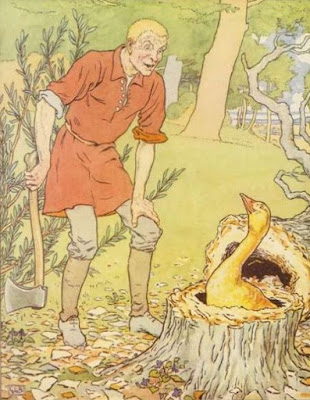
After reading through these stories, the one I'd like to focus on is The Golden Goose. It's a very simple story that can be pretty powerful, especially with kids. In this story, a golden goose sees a family in need and decides that it will help by shedding its feathers for them to sell. By doing this, it helps them live comfortably. Worried that the goose will not come back and starting to get greedy, the mother of the two daughters decides to catch the goose and pluck all its feathers. The daughters do not want to harm it, but the mother does it anyways. The feathers turn white and are not worthless, and the goose never comes back. It's such a simple lesson in not taking good things for granted, as well as not harming other living beings. Out of all the stories in Part A, this is the one I could retell in a fun, modern way! Bibliography: The Golden Goose by Ellen C. Babbitt. A man and a golden goose

Reading Notes: Jataka Tales Part B

Image
Today, my favorite story out of the second part of Babbitt's Jataka Tales was The Elephant Girly Face. I had read another student's story that was based off it, but hadn't read the original yet. In this story, king's elephant named Girly-face is known as one of the most peaceful and good elephants. One night outside her walls, some robbers talked about killing and stealing from people, so Girly-face assumed this is how they should act as well. The next morning, she kills her handler, then kills another person. The king is curious as to why, so he sends wise men to study him. In the end, they find out that if Girly-face is surrounded by good, he acts good. If surrounded by bad, he acts good. So after sending people to talk about how to be good and kind by him, he becomes the best elephant there ever was. This story does a great job covering how people act in the surroundings they grow up in. Someone born into a life of crime may never know what a life outside of crim...

Reading Notes: Jataka Tales Part A

Image
These short tales were a blast to read! Going through each one was a journey on it's own, but The Turtle Who Couldn't Stop Talking was by far my favorite. Not only was a lesson for the kids who may have this told to them, but it was just plain funny (sorry turtle). The story follows a simple event. A turtle is met by two geese who offer him an amazing new home to live. All he has to do is keep his mouth shut. At first I thought (based on the title) that this turtle would brag all about his new home, and that his showing off would come back to bite him. In this story, it's not the case because not talking meant not opening your mouth, literally. On the next day, the geese come by with a stick between them allowing the turtle to grab on with his mouth. As long as he doesn't talk, he wont open his mouth and fall. While flying over a town, the kids comment on how ridiculous this turtle is, and the turtle feels a bit offended so he begins to talk back. But talking back mea...

Week 9 Reading Notes: More Mahabharata Part B

Image
Preparations of War: Some people want peace, some people want war. The Pandavas send a messenger offering peace, and it's almost accepted, but Duryodhana refuses anything that's not war. The Battle Begins: Arjuna (Pandu) is hesitant to attack his uncle and cousins, but decides to fight. For the first time in this story, Dryodhana is actually winning! Oh no! Day two begins and The Pandavas bounce back. Soon after, Bhima (Pandu) slays many of his cousins, while Duryodhana escapes. Bhisma and Drona Fall: While there is a lack of celestial beings in this story, there is still destiny. Shikhandin was destined to kill Bhishma. The fight was everything but epic. Bhishma would not fight as Shikhandin was born a woman, so after letting his guard down, he is peppered with arrows and the cousins weep over his as he dies. Again, Duryodhana is asked for peace, but STILL REFUSES. After many confusions of a son named the same as an elephant, Drona is then killed in battle. This at last le...

Week 9 Reading Notes: More Mahabharata Part A

Image
For this week, I've chosen Richard Wilson's version called The Indian Story Book: The Five Tall Sons of Pandu . I chose this as it is a retelling but with no mention of gods or celecstial weapons, so it must portray the brothers as some very impressive warriors! I'm excited to see how this one goes. The Young Princes: Pandu has five sons, Arjuna being the best warrior of them all after training. Pandu's brother Dhritarashtra becomes king with his 100 sons after Pandu dies, and the tension begins to build between the cousins early. To show off their skills and decide the best fighter, a tourney is made and they face off. Bhima (son of Pandu) and Duryodhana get heated and the battle has to be called off. While Arjuna shows off, he is challenged by a nameless stranger (Karna). Karna is able to keep up perfectly with him and out of everyone there, KARNA is chosen to become the new king of Huga (an area controlled by Dhritarashtra). Draupadi's Swayamvara: Yudhishthir...

Week 7 Reading Notes: Mahabharata Part D

Image
Arjuna and Karna : Arjuna and Karna meet in battle. After all that Karna has done, Arjuna is restringing his bow and Karna is ready to kill him. Arjuna reminds him that it is not allowed in the rules of battle to strike down someone with a disabled weapon. Karna ignores the rules and proceeds to fire more arrows at Arjuna. Badly wounded, Arjuna restrings his bow and Karna's chariot has a wheel sink into the ground. Karna begs that Arjuna wait for him, but Arjuna recounts all the bad and dishonorable deeds done by Karna before ultimately deciding to fire on him while he's stuck. Arjuna's arrows cut of Karna's head and he falls dead on the battlefield. The Raid : Much like before, it was time for the Pandavas to be assaulted in their sleep again. As Ashwatthaman was being blocked entry by none other than Shiva, he left for the night to worship Shiva. He had nothing to sacrifice, so he sacrifices himself into his fire, and Shiva saves him. Shiva says that it is not time ...

Week 7 Reading Notes: Mahabharata Part C

Image
Arjuna and Shiva : Arjuna take s a solo adventure to the Himalayas. After slowly limiting his living supplies over months at the base of the mountain, he was able to sustain himself on only air. Mid-worship, a boar charges him, and as he shoots it with his bow, another arrow comes in at the exact same time. A large huntsman matches his anger as Arjuna claims they should fight for the kill. After loosing all his arrows into the huntsman to no avail, he offers to wrestle instead. A hand felt his heart and he immediately went to worship instead, and his offerings landed on the large huntsman. He quickly realized it was Shiva he had nearly come to blows with, but Shiva was pleased. Arjuna is granted a full set of celestial weapons, but he is not allowed to use them on weak enemies and may only use them when he is out of normal weapons. Riddles : After a long chase pursuing a stag, the Pandava brothers look for water. One by one, they approach a pong and a mysterious voice warns them no t...

Week 6 Reading Notes: Mahabharata Part B

Image
Changing my notes for this week, I want to focus on a few stories that stick out to me so I can break them down in my own stories later. Bhima and Hidimba : When the Pandavas escaped, they were forced out into the wilderness. Thankfully, they had grown up living in the wilderness already so they were somewhat prepared. In the forest, they encounter Hidimba, a rakshasa. Perfect for them (not), this was one extra hungry rakshasa, and what do they eat? Humans of course. Much like the rakshasa in the Ramayana, this one fell in love with one of our characters, Bhima. The rakshasas brother got irritated at his denial of his sister and his boasting of power. In the fight, Bhima actually drags him away from his sleeping family so he doesn't wake them up with the screams of battle! The Burning of the Forest : Krishna and Arjuna were having a nice picnic by the forest when a brahmin who turned out to actually be Agni, the god of fire approaches them. He wants to consume the forest in fla...

Week 6 Reading Notes: Mahabharata Part A

Image
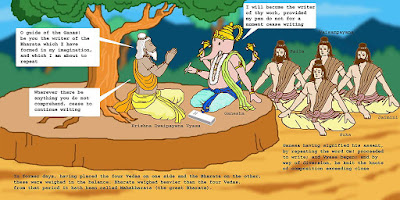
Vyasa, the writer, is also a character! That's interesting. Vyasa originally wrote this to the god Ganesha. Vyasa was able to tell the whole story without stopping, quite a feat. There are many many many characters in this epic. Again, an important character in this story Devavrata is a human, like Rama, but with the power of not one, but eight gods. He is one of eight children, all the others slain, but now he has all the powers. Vyasa's mother takes interest in King Shantanu, the main King we're focusing on so far, Devavrata's father. Devavrata's father vows that he will give the throne to his new sons instead of him if his new girl bears them. He does and Devavrata is now known as Bhishma. Instead of winning women like Rama, Bhishma instead won them in battle after defeating many people by himself with one arrow each. Of the three women he wins, he is only able to marry two, but the third will reincarnate later. She loved another man and was allowed to ...

Week 5 Reading Notes: The DIvine Archer (Part A)

Image
Unlike before, this story start off with the birth of the four sons, not before. Even as a baby Rama already has powers There is more exposition on Rama meeting Sita in this version. After love at first sight, it takes him time to actually be able to snap the bow to win Sita's hand in marriage. After a small outrage, Rama is awarded for his success with the bow of Vishnu. Parashurama who awards him is also an avatar of Vishnu. All four of the sons are married with their father there. Same as the other version, Rama is forced into exile after Bharata's mother forces Dasharatha to make him king instead of Rama. Losing Rama was a curse all along, and that helps set Dasharatha's mind at ease in his death. Bharata comes home to a dead father and is angry at his mother, so he tries and fails to get Rama to return. He places Rama's sandals at the throne for him to return to years down the road. Whereas before, the main trio seemed much more mobile, in this versio...

Week 5 Reading Notes: Ramayana Part D (Catching Up)

Image
Rama and the others can't jump like Hanuman. Rama uses his celestial weapons to threaten the god of the sea. Nala, a divine artisan is called to make a bridge. Ravana fakes Rama's death to Sita, but she learns it was fake. Rama's army is heavily injured, but healed by Garuda. Ravana's brother did not see this coming! Now we meet Kubhakarna, one of my favorite characters. He must be awoken, but for that he needs food. LOTS of food. Rama still killed him. Ravana's son Indrajit is still causing problems with his special weaponry. Hanuman takes LITERALLY THE TOP OF A MOUNTAIN back to the army and is able to heal them with the herbs that grow on it. Now Ravana tries to fool Rama into thinking Sita is dead, but he is told of the rakshasa tricks. He is then informed where Lakshmana will go to battle Indrajit. Lakshmana kills him, but that just makes Ravana angrier. Ravana ALMOST kills Lakshmana, but Hanuman again goes to the mountain and is able to heal Laksh...

Reading Notes: Ramayana Part C

Image
Rama and Laksmana go in search of Sugriva an exiled monkey-king. They are greeted by Hanuman, who becomes a devoted follower. Because Rama and Sugriva have both been exiled and lost their wives, Sugriva will help. We learn of how Sugriva was exiled and even though Rama was seeking his protection, but Sugriva ends up asking him for help. Tara, wife of Vali (Sugriva's brother) warns him that he should not fight against Rama. Rama has never been beaten (other than losing Sita) to this point. Instead of facing him head on like the rest of his fights that gave others a chance, Rama kills Vali in an ambush. This has caused a lot of discussion around it being a dishonorable fight. This could be a fun story to revisit and turn it into an honorable fight. Sugriva assumes the throne, but it is not without grieving his lost brother. Though he wanted the throne, he understands what he has had Rama do. Sugriva says he will help find Sita, but they must wait. Rama laments about what Si...